Update
And We're Off! The Study Begins
- Participants
- 30
- Tests per athlete
- 2
- Lactate samples
- 300+
Thank You to Our Sponsor
Before anything else, a sincere thank you to our sponsor whose generous support has made this study possible. As outlined in the proposal, this is a self-supported project, and that support is what allows the testing to run at the scale it now does.
Participants
The original target was N ≥ 10 men and N ≥ 10 women. In the end, 30 elite orienteers signed up — a level of interest that is genuinely exciting for a study of this size. The group is also more varied than expected, with athletes from several different countries and a broad range of competitive experience and training backgrounds.
Each orienteer will complete both conditions: the treadmill test (C1) and the marked forest route (C2). With five intervals per test, that comes to over 300 blood lactate measurements, collected alongside continuous heart rate, GPS tracks, RPE at the end of every interval, and survey data.
Timeline
Testing will take place throughout September and October. The treadmill sessions start first, and the forest tests begin in October, in line with the 2–3 week spacing between each athlete's two sessions set out in the study design.
Two Treadmills, One Protocol
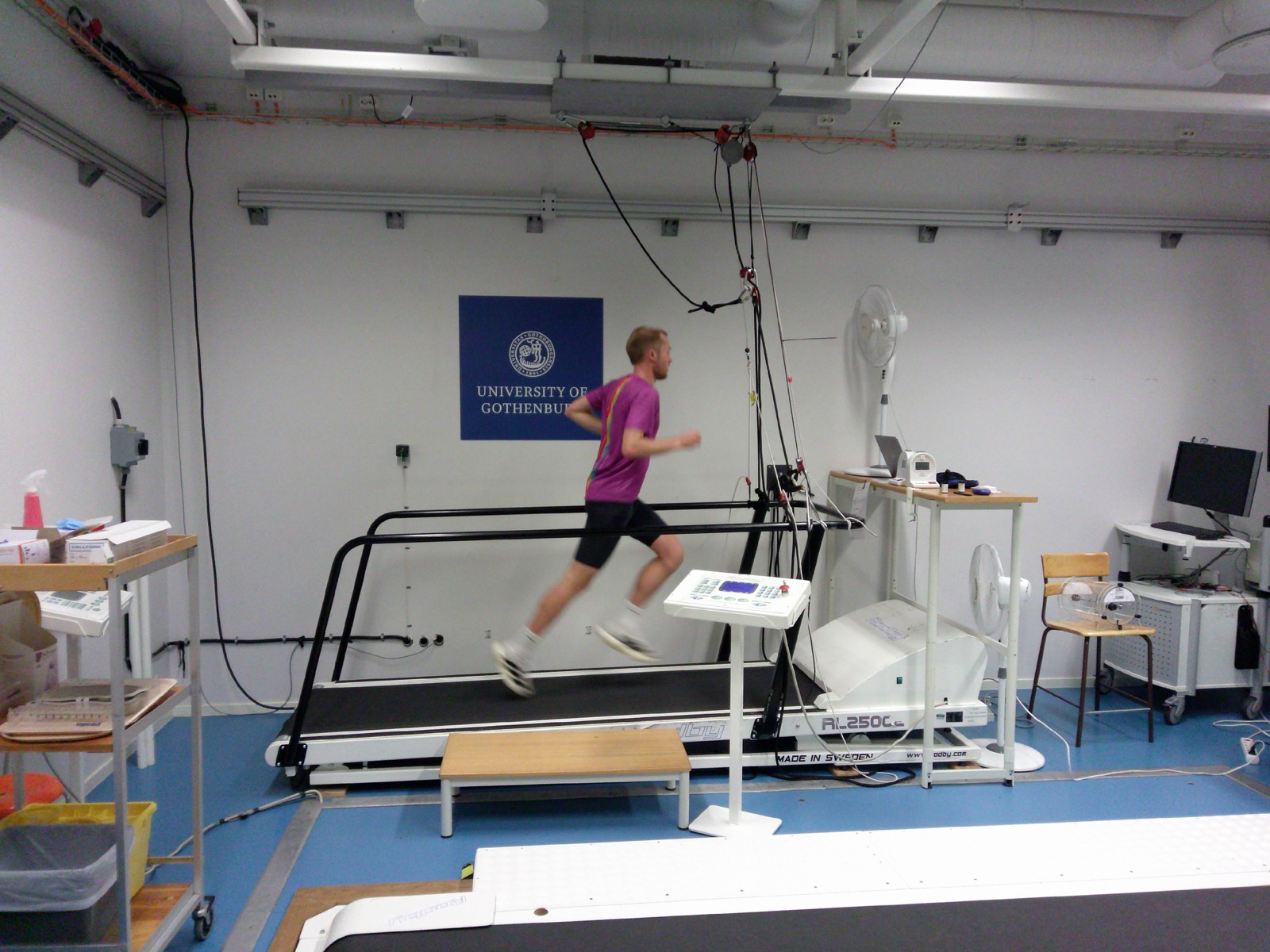
The treadmill condition is being run on two different machines, assigned according to each athlete's estimated threshold. The fastest athletes are tested at the RIU performance centre (CHP), and all other participants are tested on the treadmill at the IFK orienteering club gym.
Using two treadmills introduces an obvious risk: a displayed speed of 16 km/h on one machine is not guaranteed to be 16 km/h on the other. To reduce this, I measured both treadmills ahead of testing so that they could be calibrated and adjusted against each other. The aim is for the speeds recorded for each participant to be roughly equivalent, regardless of which machine they ran on.